
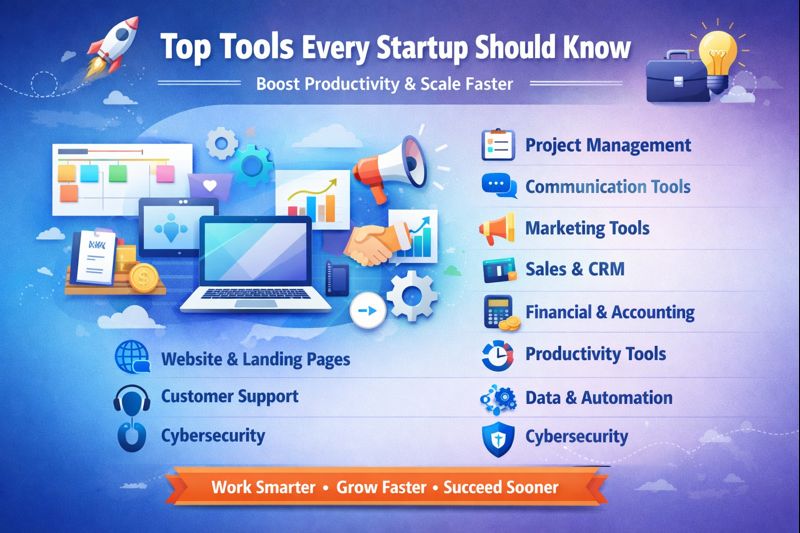
Launching a startup is exciting but also very Immense. Between the product development, marketing, sales, finance, and day-to-day operations, founders quickly realize that they can’t scale on effort alone. They need the right tools to make there work faster, smart, efficient, and cost-effective systems that reduce manual work and help teams move faster. In today’s competitive digital age, using the correct set of tools is not optional it’s the difference between moving slow and scaling rapidly. Many modern businesses even rely on growth partners like to set up their digital systems for long-term scalability.
Why Tools Matter for Startups
Tools allows startups to do more productivity with fewer resources. With tight budgets and small teams, every hour and every rupee matters. Modern tools which helps you in helps in:
 Automating repetitive tasks
Improving team productivity
Tracking performance in real time
Enhancing marketing and sales results
Delivering a better customer experience
Reducing operational costs
Making smarter decisions with data
The right tool can literally shave weeks off a project and increase revenue without increasing manpower.
Below are the top tools every startup should know categorized so you choose what fits your workflow best.
1. Project Management Tools
Good executions is the best backbone of every successful startup. Without structured project management, deadlines slip, teams get confused, and growth stalls.
a) Trello
Trello is ideal for teams that want a simple visuals workflow.
- Drag-and-drop cards
- Kanban board
- Easy task assignment
- Perfect for small teams or early-stage founders
b) Asana
Asana goes deeper with automation, workflows, dependencies, and timeline views.
- Advanced task management
- Automation
- Integrations with Slack, Drive, Notion
- Great for scaling teams
c) Notion
A complete all-in-one workspace.
- Wikis
- Notes
- Project tracking
- Databases
Perfect for founders who want everything organized in one place.
Why its matters:
With the right project management tool, your team stays aligned, productive, and get focus on the work and moves the business forward.
2. Communication & Collaboration Tools
Startups rely on fast communication—slow communication leads to slow companies.
a) Slack
The most popular workplace communication tool.
- Channels for teams
- File sharing
- Integrations
- Faster than email
b) Microsoft Teams
Ideal for teams already using Office 365.
- Video calls
- Chat
- File collaboration
c) Zoom
Still the easiest and most reliable tool for video meetings.
- HD video
- Screen sharing
- Webinars
Why its matters:
Smooth communication means fewer misunderstandings and more productive execution.
3. Marketing Tools
Marketing is where startups win or lose. If your audience doesn’t know you exist—you don’t exist.
a) Canva
Perfect for founders who are not designers.
- Social media graphics
- Ads
- Pitch decks
- Presentations
b) Google Analytics
To track who visits your website, from where, and what they do.
- Audience insights
- Page performance
- Conversion tracking
c) Meta Ads Manager
For running paid ads on Facebook and Instagram.
- Audience targeting
- Campaign scaling
- Lead generation
d) Mailchimp
Beginner-friendly email marketing.
- Automation
- Audience segmentation
- Templates
Why its matters:
The right marketing tools help you grow visibility and acquire paying customers faster.
4. Sales & CRM Tools
A startup survives ONLY if it sells. CRM tools help track leads, automate follow-ups, and increase conversions.
a) HubSpot CRM
One of the best free CRMs available.
- Pipeline management
- Automation
- Lead tracking
b) Zoho CRM
Budget-friendly and customizable.
- Sales automation
- Lead management
- Reporting
c) Pipedrive
Super easy for teams who want a visual sales pipeline.
- Deal tracking
- Forecasting
- Email integrations
Why its matters:
Without CRM, leads slip through the cracks and revenue never scales.
5. Financial & Accounting Tools
Startups fail when they ignore cash flow. Financial tools help founders track expenses, revenues, budgets, and taxes easily.
a) QuickBooks
Most popular accounting tool for small businesses.
- Invoices
- Expenses
- Profit & loss statements
b) Zoho Books
Affordable alternative with strong features.
- GST support
- Automation
- Reports
c) Razorpay
For payments, subscriptions, and invoicing.
- Payment gateway
- Subscription management
Why it matters:
When your finances are organized, investors trust you and scaling becomes easier.
6. Productivity Tools
Founders are constantly juggling tasks. Productivity tools keep you fast and efficient.
a) Google Workspace
- Gmail
- Drive
- Docs
- Sheets
Everything in one ecosystem.
b) Microsoft 365
Enterprise-level productivity for serious teams.
- Outlook
- Word
- Excel
- PowerPoint
c) Evernote
Great for storing notes, ideas, plans, and reminders.
Why its matters:
Productive teams work smarter, not harder.
7. Website & Landing Page Tools
Every startup needs an online presence—your website is often your first impression.
a) WordPress
Flexible and customizable.
- Themes
- Plugins
- SEO tools
b) Webflow
No-code builder for premium designs.
- Visual editing
- Animations
- CMS
c) Elementor
Perfect for WordPress users wanting design freedom.
- Drag-and-drop
- Responsive pages
d) Shopify
Ideal for ecommerce startups.
- Store management
- Payments
- Apps
Why its matters:
A strong website builds trust and converts visitors into customers.
8. Customer Support Tools
Support is the part of the growth. Happy customers bring referrals and repeat business to you.
a) Intercom
Live chat, automation, and customer engagement.
b) Freshdesk
Budget-friendly support tool.
- Ticketing
- Chat
- Automation
c) Tidio
Great for live chat + chatbot features.
Why its matters:
Fast customer support = better retention = more revenue.
9. Data & Analytics Tools
Data is the new and the main source of oxygen for startups.
a) Google Data Studio (Looker Studio)
Visual dashboards for marketing & sales data.
b) Hotjar
See how users behave on your website.
- Heatmaps
- Recordings
- UX insights
c) Mixpanel
Great for SaaS and product startups.
- User behavior analytics
- Funnels
- Retention tracking
Why its matters:
Better data → better decisions → faster growth.
10. Automation Tools
Automation is how startups scale without increasing team size.
a) Zapier
Connect apps and automate workflows.
b) Make (formerly Integromat)
More advanced automation for complex needs.
c) Automate.io (India-based)
Simple automation for beginners.
Why its matters:
Automations saves time, reduce manual errors, and increase the productivity.
11. Cybersecurity Tools
A single cyberattack can destroy a startup’s reputation.
a) LastPass
Password manager for teams.
b) 1Password
Secure vault for sensitive data.
c) Cloudflare
Protects websites from attacks.
- SSL
- Firewall
- CDN
Why its matters:
Security builds trust and protects your business from expensive risks.
12. HR & Team Management Tools
As your team grows, HR tools keep everything smooth.
a) Keka
India’s most popular HR tool.
- Payroll
- Attendance
- HRMS
b) Zoho People
Great for small teams.
- Leave management
- Employee database
c) BambooHR
Perfect for global teams.
- Onboarding
- Performance tracking
Why its matters:
Good HR tools save time and make employees happier.
Conclusion
Startups that grow fast don’t work harder they work smarter. The right tools make there work Faster and speed up execution, improve customer experience, and increase revenue with fewer resources.
Whether you’re building your first MVP or scaling your startup globally, these are the top tools every startup should know to operate like a high performance business and grow there Business.